
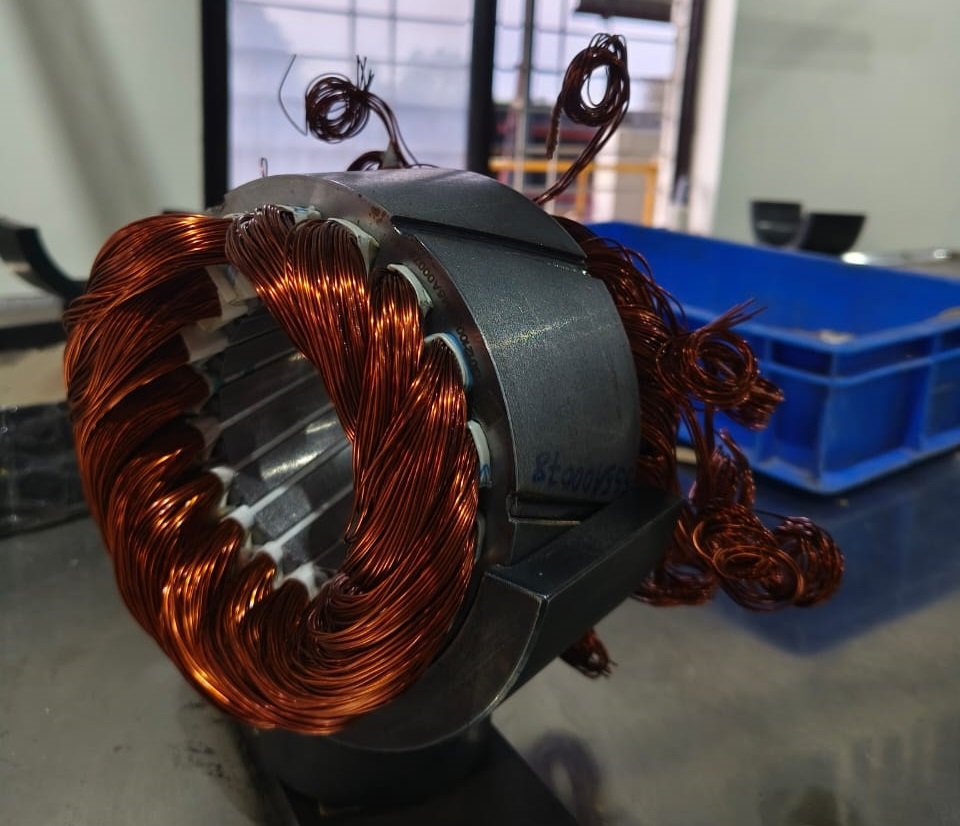
Motor windings serve multiple functions that contribute to efficient motor performance:
 Creating Magnetic Fields
When electrical current flows through the windings, they generate a magnetic field, which is essential for the motor’s function.
Generating Torque
The interaction between the stator and rotor magnetic fields produces torque, which drives the motor’s rotation.
Providing a Current Path
Windings act as a conduit for electrical current, ensuring that the motor receives power to operate smoothly.
1. Stator Windings
 Located in the stationary part of the motor (stator). Responsible for generating a rotating magnetic field that drives the motor.
2. Rotor Windings
Found in the rotating part of the motor (rotor). Interacts with the stator’s magnetic field to produce torque and movement.
3. Three-Phase Windings
Used in industrial AC motors for high efficiency and performance. Creates a smooth sinusoidal Magneto-Motive Force (MMF) distribution, reducing losses and enhancing power output.
4. Single-Phase Windings
Found in single-phase motors commonly used in household and small industrial applications. Typically consists of a main winding and an auxiliary winding for startup assistance.