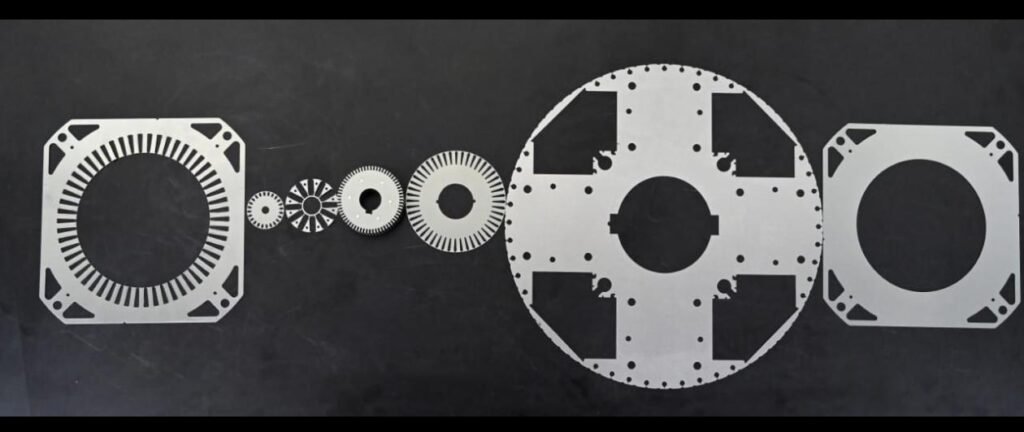
Motor Laminations

Shree Kedareshwar Engineering has been committed to providing high-quality motor lamination services to the motor core industry. As a fully integrated manufacturer, we specialize in standard and custom electric motor laminations, including rotor and stator laminations. Our flexible and customized solutions are designed to meet the unique needs of our customers, making us a trusted supplier for the automotive, industrial, aerospace, and electrical industries.

What Are Laminations in an Electric Motor?

Motor laminations form the core of an electric motor’s stator and rotor. They consist of stacked thin metal sheets that are either welded or bonded together, sometimes with a protective coating. Instead of using a solid metal piece, these thin laminations help reduce eddy current losses, which can generate excessive heat and cause electrical and magnetic inefficiencies.

For larger electric motors, laminations are made from materials such as cobalt-iron alloys, nickel alloys, silicon steel, or thin-gauge electrical steel. Due to material constraints and to minimize waste, segmenting motor laminations is often necessary during manufacturing. Electrical steel coils are typically limited to a width of 48 inches, making specialized equipment and expertise essential for producing large motor laminations.

Precision is key in every step of the process, from laser cutting or stamping the metal sheets to coating, bonding, or welding them together to create the motor core. Our high-quality motor laminations are used across industries such as industrial manufacturing, power generation, aerospace, and transportation, ensuring efficient and reliable performance in heavy machinery.

Stator Laminations

SKE Punching is a trusted name in the motor and generator industry, renowned for producing high-precision stator laminations tailored to exact customer specifications. Upholding the highest standards of quality control, we ensure superior performance in every component we manufacture. At ske punching , we extend this same commitment to excellence by offering value-added services for Godrej Motors Stator Core Assembly. Our streamlined process allows service and repair customers to optimize their internal resources, focusing on their core expertise while we handle the precision manufacturing.

Stack Laminations

Stack punching is a widely used technique in the production of stator and rotor laminations for electric motors. It involves cutting laminations from electrical steel sheets and stacking them to form the motor’s core. This method is preferred for its efficiency in large-scale manufacturing and its ability to maintain precise alignment of the laminations, ensuring optimal motor performance.

C Type Laminations

C-type lamination refers to a specific shape or design of stator or rotor lamination used in electric motors, particularly universal motors, small AC motors, or certain DC motor designs. The name "C-type" comes from the general shape of the lamination core—it resembles the letter "C" when viewed from the side, where the open side of the "C" represents the slot opening for winding insertion. Unlike the more commonly used circular or E/I core laminations, C-type laminations are open-frame and used when there's a need for simplified coil winding or specific magnetic path requirements. These are more common in frame-type or bracket-type stators, especially in applications where the winding needs to be placed around the core instead of inserted into inner slots.

Features of C-Type Laminations

  1. Shape and Structure:

    • One side of the lamination is open, allowing easy access for winding.

    • Usually made from cold-rolled, non-oriented electrical steel to minimize core loss.

  2. Punching Process:

    • C-type laminations are manufactured through progressive or compound die punching.

    • The punching process must ensure minimal burrs, tight tolerances, and consistent dimensions to maintain performance.

  3. Applications:

    • Found in low-voltage motors, fan motors, grinders, or appliances where compact size and ease of assembly are priorities.

    • Suitable for manual or semi-automatic winding processes.

  4. Advantages:

    • Easier coil winding compared to traditional closed slot stators.

    • Simplified assembly process.

    • Lower tooling cost in some cases.

  5. Design Considerations:

    • Magnetic circuit must be carefully designed to compensate for the air gap at the opening of the “C”.

    • Core losses and eddy currents must be controlled through proper lamination thickness and insulation coating.

Scroll to Top